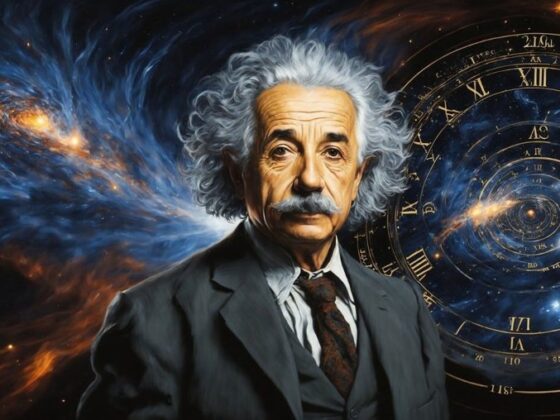
The concept of time has always been a fundamental aspect of our existence, shaping the way we perceive and navigate the world around us. However, when one delves into the intriguing realm of special relativity, a startling revelation emerges: time is not an absolute constant but rather a dynamic entity that can warp and stretch, slowing down the faster one travels. This fascinating phenomenon, known as time dilation, is a cornerstone of Albert Einstein’s theory of relativity and challenges our intuitive understanding of time itself. In this article, we embark on a journey to unravel the mysteries behind why time slows down as we approach the speed of light, exploring the when, why, and how of this mind-bending aspect of the universe.
Why Does Time Slow Down The Faster You Go?
Time slows down the faster you go due to the effects of special relativity, a groundbreaking theory proposed by Albert Einstein in the early 20th century. This phenomenon, known as time dilation, is a consequence of the theory and can be understood through the following key concepts:
- The Speed of Light (c): In special relativity, the speed of light in a vacuum, denoted as “c,” is considered an absolute constant. It’s the fastest speed at which any information or matter can travel in the universe.
- Relativity of Simultaneity: According to Einstein’s theory, the simultaneity of events is relative, meaning that two events that are simultaneous for one observer may not be simultaneous for another moving at a different velocity.
- Lorentz Transformations: Special relativity introduced the Lorentz transformations, a set of equations that describe how space and time coordinates change when transitioning from one inertial frame of reference to another moving at a constant velocity relative to the first frame.
The key idea behind time dilation is that as an object approaches the speed of light (c), its relative velocity causes time to pass more slowly for that object compared to an observer at rest. This effect becomes increasingly significant as the object’s velocity approaches the speed of light.
The Lorentz factor (γ), which is a part of the Lorentz transformations, quantifies time dilation:
γ = 1 / √(1 – v²/c²)
In this equation:
γ is the Lorentz factor.
v is the velocity of the moving object.
c is the speed of light.
As v approaches c, the denominator of the Lorentz factor becomes very close to zero, making γ extremely large. This means that time dilation becomes more pronounced as an object’s velocity approaches the speed of light.
Einstein’s Theory Of Special Relativity
Einstein’s Theory of Special Relativity, developed by Albert Einstein in 1905, is one of the most profound and groundbreaking theories in the history of physics. This theory fundamentally altered our understanding of space, time, and the nature of the universe. Here are the key principles and concepts of special relativity:
1. Invariance of the Speed of Light: Special relativity is built upon the principle that the speed of light in a vacuum, denoted as “c,” is an absolute constant. It is the same for all observers, regardless of their motion. This postulate challenged the classical understanding of Galilean relativity, where the speed of light would vary depending on the motion of the source or observer.
2. Relativity of Simultaneity: According to special relativity, the concept of simultaneity is relative. Two events that are simultaneous for one observer may not be simultaneous for another moving at a different velocity. This leads to the idea that time is not an absolute concept but depends on one’s perspective.
3. Time Dilation: Time dilation is a consequence of special relativity. It states that as an object moves at a constant velocity (relative to an observer), time passes more slowly for that moving object compared to an observer at rest. The faster the object moves, the more pronounced the time dilation effect becomes.
4. Length Contraction: Length contraction is another consequence of special relativity. It asserts that as an object’s relative velocity increases, it appears shorter in the direction of motion when observed by a stationary observer. This effect is most significant at high speeds.
5. Lorentz Transformations: The Lorentz transformations are a set of mathematical equations that describe how space and time coordinates change when transitioning from one inertial frame of reference (a coordinate system in which an observer is at rest) to another moving at a constant velocity relative to the first frame. These transformations incorporate time dilation and length contraction.
6. Mass-Energy Equivalence: Special relativity also introduced the famous equation E=mc², which relates energy (E) and mass (m). It shows that mass and energy are interchangeable, with mass contributing to an object’s energy content even when it is at rest. This principle has profound implications for nuclear reactions and the behavior of particles at high energies.
7. Cosmic Speed Limit: Special relativity establishes that nothing with mass can accelerate to or beyond the speed of light. As an object with mass approaches the speed of light, its relativistic mass increases, making it increasingly difficult to accelerate further. Thus, the speed of light serves as an ultimate cosmic speed limit.
The Equations Of Time Dilation
The equations of time dilation are fundamental to understanding how time passes differently for objects in relative motion, as described by Einstein’s Theory of Special Relativity. Time dilation can be expressed using the Lorentz factor (γ), which quantifies the degree of time dilation experienced by a moving object. The equation for time dilation is as follows:
γ = 1 / √(1 – v²/c²)
In this equation:
γ represents the Lorentz factor, which is a dimensionless quantity.
v is the velocity of the moving object relative to an observer at rest.
c is the speed of light in a vacuum, which is approximately 299,792,458 meters per second (m/s).
The Lorentz factor γ determines the extent to which time dilation occurs. When an object is at rest (v = 0), γ equals 1, indicating that time dilation is not a factor, and time behaves as expected in classical physics. However, as the object’s velocity (v) approaches the speed of light (c), the Lorentz factor becomes significantly greater than 1. This means that time dilation becomes more pronounced as an object’s velocity gets closer to the speed of light.
To understand the practical implications of this equation, consider an example:
Suppose an observer on Earth (at rest) is watching a spacecraft traveling at a velocity of 0.8c (80% of the speed of light). To calculate the time dilation experienced by the astronauts on the spacecraft, you can plug the values into the equation:
γ = 1 / √(1 – (0.8c)²/c²)
γ = 1 / √(1 – 0.64)
γ ≈ 1 / √0.36
γ ≈ 1 / 0.6
γ ≈ 1.67
This means that for the astronauts on the spacecraft traveling at 0.8c, time passes approximately 1.67 times more slowly than it does for the observer at rest on Earth. In other words, one second for the astronauts corresponds to 1.67 seconds for the Earth-based observer.
Practical Applications Of Time Dilation
Time dilation, a consequence of Einstein’s Theory of Special Relativity, may sound like a purely theoretical concept, but it has real and practical implications in various scientific and technological domains. Here are some practical applications of time dilation:
Global Positioning System (GPS):
One of the most well-known practical applications of time dilation is in the Global Positioning System (GPS). GPS relies on a network of satellites orbiting the Earth, and accurate timekeeping is crucial for its precision.
Because satellites are in motion relative to Earth and are at a higher gravitational potential, both special and general relativity effects come into play. The satellites experience time dilation, causing their onboard atomic clocks to run slightly faster than clocks on the Earth’s surface.
If time dilation effects were not considered and corrected for, GPS accuracy would degrade by several meters per day, rendering it less useful for navigation and location-based services.
Particle Accelerators:
Particle accelerators, such as the Large Hadron Collider (LHC), accelerate particles to nearly the speed of light to study their fundamental properties.
Time dilation affects the lifetimes of these high-energy particles. For example, muons produced in the upper atmosphere and reaching the Earth’s surface should decay rapidly, but due to their high velocities and time dilation, they reach the surface and can be detected.
Space Exploration:
Spacecraft traveling at high speeds, especially those on interplanetary or interstellar missions, experience time dilation.
Accurate calculations of time dilation are essential for mission planning and navigation. Without corrections for relativistic effects, the spacecraft’s position and timing could be significantly off course.
Satellite Communications:
Communication with satellites in geostationary orbit is affected by time dilation. These satellites are farther from Earth’s gravitational center, which leads to a slight time dilation effect.Precise synchronization of signals is crucial for satellite-based communication systems, and accounting for time dilation ensures accurate data transmission.
Atomic Clock Experiments:
Experiments using highly precise atomic clocks on Earth and in space have confirmed time dilation effects.
These experiments help test the predictions of special relativity and demonstrate that time does indeed pass differently in relative motion.
Cosmic Observations:
Time dilation is relevant when observing distant astronomical phenomena, such as supernovae and gamma-ray bursts.
The light from these events may experience time dilation during its journey to Earth, affecting the observed light curves and allowing scientists to glean information about the events’ true properties.
Conclusion
In conclusion, the phenomenon of time dilation, as elucidated by Einstein’s Theory of Special Relativity, challenges our intuitive understanding of time and space. Its practical applications, from ensuring the precision of GPS to advancing our knowledge of particle physics and enabling accurate space exploration, underscore its tangible relevance in the modern world. Time dilation reveals the profound interconnectedness of the universe, where the fabric of spacetime warps with speed and gravity, prompting us to explore further the mysteries of the cosmos and redefine our perception of time itself.